| Part 1 The Theory of Faith | Hirohumi Hoshika |
Chapter 2 Views that Prevent from Approaching Christianity (17)
Supplement 2 Model for Christian Ethics
Table of contents within this page
〈The hierarchy and separation of faith and ethics in Christianity〉
〈The weakening of Christian ethics due to the structure of faith first, ethics second〉
〈The separation of faith and ethics avoids fundamentalism and restores Christian ethics〉
〈The separation of facts and ethics in Christianity and Kantian philosophy〉
〈"Paul Equivalence" as a Principle of Acceptance of the Fact of Resurrection〉
〈Preface〉
It is dogmatics that defines what kind of faith the Christian faith should be, and it is the theory of faith that is the question of how we can arrive at that faith. Similarly, Christian ethics will be explored what kind of ethics it should be and how it can be incorporated into one's own ethical consciousness. This is the problem of Christian ethics.
In addition to dogmatics, successive creeds and confessions of faith have defined the Christian faith. However, it can be said that there has been no solid theory of faith regarding how one can believe in the faith defined there. It has just been said that “the Holy Spirit gives faith,” and if you ask any church, you will just hear this answer. This is primarily due to a lack of understanding of how the original Christian faith was established in the early church.
That is to say, in Christian faith, the difficulties lie in the theory of faith rather than in dogmatics, but this essay clarifies the theory of faith in Part 1, especially in Chapter 3.
On the other hand, when it comes to Christian ethics, it is more difficult to determine the content than to clarify the mechanism of practice. For those who have received salvation through faith, practicing morality is natural, and above all, since practicing morality is a matter of will――in contrast to faith which cannot be had by will alone, it may be said that there is not much need to go to the trouble of explaining it.
By contrast, there is difficulty in determining what Christian ethics should be. It is not enough to simply collect commands from the Bible, and there are clearly some rules in the Bible that require historical verification. Not only that, the Old Testament contains commands regarding aggression and murder, and how to handle these commands in a way that creates a "desirable Christian ethics to strive for" becomes a difficult question.
Furthermore, I myself have had my own unique struggles with Christian ethics, conflicts with the way of life I have embraced, and these have been difficult to resolve, leading me to write in the final section of Chapter 1, Gigue, about keeping faith and ethics separate.
It's a way of life that tries to chase two rabbits at once, and is probably unprecedented for a Christian to adopt. However, I wrote it as there was no other choice. This judgment was unavoidable due to the doubts about biblical ethics mentioned in Arguments 1-2 and through my long-term knowledge of church teachers and members.
However, after some time had passed, I came to believe that Christian faith and Christian ethics can be, and should be, separate from each other. This is because, when I returned to Luther's Protestant theological principle of "sola fide (faith alone)", I came to the realization that this gives Christian ethics independence from faith.
Once a principle is obtained, it can be used to construct a ology. Regarding what also Christian ethics should be, I came to believe that it was possible to construct a model of Christian ethics based on the principle of "faith alone", and this resolved the long-standing problem of Christian faith and ethics.
Hence, in this supplement, I would like to develop the principle of interpretation of the ethical commands of the Bible, which I stated earlier in Argument 1-3 as the "Bible Literal-Not-Based Ethics", to obtain a model of Christian ethics.
〈The hierarchy and separation of faith and ethics in Christianity〉⇧
Paul taught about salvation――salvation from Condemnation in the Final Judgment――:
"For it is by grace you have been saved, through faith—and this is not from yourselves, it is the gift of God—not by works, so that no one can boast." (Eph. 2:8-9)
"And if by grace, then is it no more of works:" (Rom.11:6a)
At this time, Paul had discovered a new way of faith that was different from Jewish faith. It is faith that righteousness of God is not given by keeping the law, but by God's mercy in forgiving our sins.
In Judaism, obedience to the law was a condition for salvation, so works and salvation are inseparable, and ethics and faith are linked. But Paul excluded works from the requirements for salvation. The understanding of faith resulting from this is clear. Only "faith alone" can be related in God's salvation.
So what about ethics? What happens to ethics itself when faith, which had previously been a set, is separated from ethics?
Paul's principle of faith that God's salvation is separate from the works of the law teaches a new way of faith called Christian faith. However it also brings about a new understanding of ethics separate from salvation. Let's check this out below.
First, the position of the Old Testament law as taught by Jesus is as follows:
1.The Law is not destroyed.(Mt.5:17-18)
2.To be saved, one must acquire a righteousness that exceeds the righteousness of the Law.(Mt.5:20)
3.However, with men it is impossible.(Mk.10:27)There is much hypocrisy among those who strive to be lawful in order to attain righteousness.(Mt.6)But the fundamental problem with salvation is not that, but rather that men are unable to acquire God's righteousness in the first place.
In the Sermon on the Mount, Jesus said "You have heard that it was said ..., But I tell you ..." and gave a new law linking it to the Old Testament law. It is an ethics based on God's perspective, and it teaches that living in a worldview that includes God leads to faith in knowing God, and that actions that take into account the existence of a Heavenly Father are beneficial to people.(Chapter 1 - Essay 2)
Jesus spoke these things to the Jews. Although Jesus' view of God as Father was new to them, it was not difficult for them to live by his teachings. This is because they were all already Jewish believers who believed in the same God that Jesus taught.
Jesus' Sermon on the Mount seems to be a teaching on ethics, but it also seems to teach faith in God as a loving Father. The thoughts about God that are preached there are beautiful, and the way Jesus teaches people to live is thoughtful. The ethics taught by Jesus are high and difficult, but not rigid severity as obligations imposed for salvation. In Jesus' teachings, faith and works are peacefully linked, which was familiar to the people of Israel, who had traditionally considered faith and works to be one.
At this time, Jesus' forerunner, John the Baptist, was preaching repentance, and those who had received the "baptism of repentance" from John and heard Jesus' preaching would have been more easy to accept his teachings. And those who had not yet been baptized by John could simply come to John the Baptist, who was still alive at the time, after coming to know God as the loving Father taught by Jesus and correcting their faith that placed the law in God's place.
However, the way Jesus' teachings were perceived changed with the death of Jesus, which was brought about by the Jews who had heard his preaching and had been exposed to many of his works, and with the birth of Christianity, a religion clearly distinct from Judaism, which emerged after his resurrection.
After the death and resurrection of Jesus, the Christian faith established by Peter and Paul was a new way of believing for everyone. In Jews, they have the Jewish faith but do not know about Christian faith. The Jesus they once knew no longer belongs to Judaism but to Christianity.
Therefore, it became difficult for the Jews to accept Jesus' teachings while reconciling them with their own faith as they had done before. Those who support the teachings of Jesus must first have a Christian faith whose central doctrine is the meaning of Jesus' death on the cross and resurrection.
This signifies that the faith and ethics in Jesus' Sermon on the Mount, which had appeared as one to the Jewish people, were now ordered. This is because, in order to follow Jesus' teachings, faith was required first. Moreover, this faith is not faith in the Kingdom of God or God the Father as taught by Jesus, but faith in Jesus Christ as taught by the apostles.
This faith in Jesus as Christ then becomes linked to the faith that was once contained in Jesus' teachings; namely, Jesus' faith in God the Father is continuous with the apostles' faith in Jesus. This begins to shift the relationship between faith and ethics from one of hierarchy to one of separation.
This is because, as the faith taught by Jesus is drawn to the faith taught by the apostles, the ethics taught by Jesus are left behind from the faith and come to be understood simply as a code for Christians. This is how Jesus' preaching was received after the apostles, and it was the beginning of the decoupling of faith and ethics.
This structure of faith first, ethics second was reinforced by the early church's attempts to separate from Judaism.
The outline of what happened after the founding of the early church is known from the Acts of the Apostles, but the apostolic council recorded in Chapter 15 concerned the handling of the Old Testament law in Christianity. The question of whether works of the Old Testament law were necessary for salvation in addition to faith in Jesus was debated, and as a result, the necessity of such works was formally rejected, albeit with a minor compromise.
However, even after the Apostolic Council, the idea of legalism was deeply rooted in Christianity, which was born from Judaism, and the Apostolic Epistles show that there continued to be teachers who preached the law as a condition for salvation. Galatians 2 records that even Peter, the chief apostle, was rebuked by Paul for pandering to Jewish converts and softening his stance.
"Faith alone" was the doctrine that separated Christianity from Judaism and was its lifeline, so compromise was not allowed here. The doctrine fundamentally changes the view of the relationship between God and man that is inherent in legalism.
The understanding that we can be saved only by receiving forgiveness through God's mercy is the path to maintaining a correct Christian view of God. Our salvation and judgment are left solely to God's will. Any ambiguity in this would mean a return of Christianity to Judaism. It was Paul, an elite member of the Jewish Pharisee sect, who understood that danger well.
In this way, the fledgling Christianity was protected by Paul and its doctrines were established, and it is easy to imagine that at this time a structure of faith first and ethics second was firmly established within the church. Paul rejected not ethics in general, but specifically the Old Testament law—that is, the Old Testament law as it was understood to be a condition for salvation. But whatever the meaning, subordinating Old Testament law to faith was perceived as subordinating ethics to faith.
In particular, since the Old Testament law was ethics itself for the Jews, the fact that they—who had been central members of the early church—rejected the law further reinforced the hierarchical understanding that faith came first and ethics second. Also, to Gentiles, Paul's teaching that "salvation does not depend on the works of the law" sounds like "salvation does not depend on morality." This is not wrong; it is exactly true that salvation does not depend on morality, but even here, a hierarchical understanding arises that places faith first and ethics second.
Additionally, the structure of faith first, ethics second is perpetuated by the nature of ethics as set forth in the New Testament. From an ethical point of view, Christian ethics is a type of ethics that is based on principles and is not a collection of detailed commands. As stated in Arguments 1-3, there are two basic types of ethics in the New Testament: "faith-based ethics," which provides the motivation for ethics, and "command-based ethics," which indicates the purpose of ethics.
However, these are merely the basic principles of ethics, namely, "Be as one who has received God's mercy" (faith-based ethics) and "Love your neighbor as yourself" (command-based ethics), and do not provide any more specific rules. Ethical rules that lack specificity can give believers moral immunity.
Faith has a "salvation" that is achieved by it, but principled ethics has no doctrinal goal that is achieved by it. In other words, with this type of ethics, there is no indicator to know when it has not been achieved, and it is left up to the believer to decide, which allows the believer to avoid questioning himself about it. This, combined with the Christian understanding of faith as "faith alone," is a factor that weakens the ethics of Christians.
This faith-ethics structure, faith first, ethics second, has implications in two directions. One is the weakening of the ethical consciousness of Christians, as mentioned above, which can be said to be a mostly negative influence. The other is the direction toward Christian ethics becoming more detached from the text of the Bible, which can be a positive influence. Let's look at this situation below, starting with the bad side.
〈The weakening of Christian ethics due to the structure of faith first, ethics second〉⇧
The hierarchy of faith first and ethics second undoubtedly demonstrates the importance of ethics, even though it is second. But the Church sometimes gives a false impression on this point. One of the church's appeals to non-believers involves moral criticism. The Church teaches that while there may be morally honorable people in the world, it is not human virtue that God values.
God asks about our status, not our deeds. God seeks the status of salvation that can be obtained by putting on the Lord Jesus Christ (Romans 13:14; Matthew 22), but moral people are satisfied with their own fine clothing and do not seek God's salvation. In this way, the Church preaches that morality is an obstacle to faith.
Originally, the teachings of salvation do not deny ethics or morality, and this type of preaching is directed at non-believers, but believers who gather in churches interpret it in a way that is convenient for them. In other words, what is important is faith, and morality is not required. Paul's teaching of "faith alone" came to be understood as meaning "As long as you have faith, you are fine."
I myself later realized that I had written the following in this essay. "The ethical teachings of the Bible, like the 'heavenly teachings,' are not the gateway to the Christian faith, nor are they the core of it."
Because of these things, it is not uncommon for Christian believers to become people who are far removed from moral consciousness. Some people mistakenly believe that having received God's salvation makes them good people. And sometimes, after acquiring what is called “Christian-like” behavior, it gradually becomes second nature.
However, what are those who have been baptized in the church? It would be correct to understand him as "someone who was simply saved". To say "a good man who is saved" is as much an expression of ignorance about salvation as to say "a cheerful man who is saved". Being religiously saved has nothing to do with one's ethical level.
When Christians are unaware of their own insincerity, and do not doubt the correctness of their own judgments or responses because of their sense of faith, or because they have lived in the church for decades, or because they are called teachers in the church, the situation becomes troublesome. Japanese people have always been good at concealing their intentions toward others with gentle attitudes and words, but once people become Christians, they become even more likely to do so.
But the love in one's heart is not revealed by how attitude one approaches the other person with or what one says to them. Moreover, the individual's own awareness of how much one cares for the other person is not the indicator. It just shows in how one treats other person.
In hospitals and nursing homes, doctors and caregivers, by the nature of their profession, explain the condition of residents to their families in a calm manner and with gentle words. However, families must not be fooled by such outward behavior, but must look only at how they intend to treat the resident. This is because facilities may try to reach an understanding with the families and treat sick people and residents, who are a nuisance to both parties, in a way that is convenient for the facility and their families rather than for the identical person.
In the business world, we may also experience our business partners saying things like, "I appreciate your work and respect you." After the meeting, we are sometimes even seen off outside the office. However, it is common knowledge that such words and actions are merely polite formalities; the other party's true intentions are revealed in the form of the deal and the terms of the contract.
God has dealt with us to salvation. God treated us worthless ones in such a way. There is God's love there. This will create a chain reaction of love in our hearts. This is the starting point of Christian ethics. God demanded of us not morality first, but the acceptance of Christ's redemption. This is to ensure our status in heaven and at the same time enable us to have love without a facade on earth.
If morality takes precedence, we will practice superficial morality that does not come from love. But if morality is not required, this becomes less likely. The structure of faith first should function in this sense to ethics; it does not mean ethics can be disregarded.
〈The separation of faith and ethics avoids fundamentalism and restores Christian ethics〉⇧
The separation of faith and ethics allows each to have a different way of interpreting the Bible; namely, passages of the Bible relating to faith interpret literally, based on the "fact-dependent of the faith", while commands relating to ethics interpret not literally, based on the "non-fact-dependent of the ethics". (Argument 1-3).
As stated in Arguments 1-3, "non-fact-dependent of the ethics" means interpreting an article in a way that extracts its meaning at the time it was written, and as will be discussed later, it also means reinterpreting the command in accordance with the teachings of Jesus.
The two interpretations, fact-dependent and non-fact-dependent, are no longer inconsistent because the separation of faith and ethics allows each domain to have different principles. If Christianity is a religion in which faith and ethics are one, then these two ways of interpreting the Bible cannot be considered necessary and must be seen as arbitrary. In that case, taking everything in the Bible literally becomes the only correct way of interpreting the Bible in orthodoxy, and the faith inevitably becomes fundamentalist.
Religious fundamentalism is the idea that pure faith means following the commands written in scripture to the letter, regardless of whether they violate human rights. Incomplete to carry out commands is incomplete to have faith, and it is action that is the exercise of faith. In other words, in this religion, works and faith are one.
In fact, since the surest way to avoid falling into religious fundamentalism is to not believe in religion, some religious people try to avoid becoming fundamentalists by incorporating secularism and lack of enthusiasm into their faith. Secularism in faith means compromising with common sense, and unenthusiasm means not practicing the doctrine as it is. However, this approach only makes one a secular believer who is not a model of faith, and is not a fundamental solution to fundamentalism while maintaining the purity of one's religiosity.
Alternatively, when people try to take the commands of the scriptures literally, it may not necessarily be because of religious sincerity, but simply because they find commands that suit them and seek to attribute the authority of the scriptures to them. In other words, fundamentalist behavior can sometimes be triggered by blatant secularism disguised as religion.
In any case, national beliefs based on or utilizing these fundamentalisms can be found in the state of Israel and other Islamic countries today (as of 2025), and as a result, it is well known around the world what burden their "religious correctness" places on their own people and neighboring countries.
Something called patriotism which is shady should not be allowed to grow too large. Patriotism should be limited to the extent of cheering on one's country's athletes at international sporting events, just as one cheers on family and acquaintances at a local sports day. This is because passion beyond that should be directed toward love of mankind, not patriotism.
Faith, too, is, in a sense, shady or unknown, and should be considered, at most, to be respected only to the same extent as ethics. We should always remember that our faith is only for our own salvation. Therefore, something like that should not exceed the fundamental rights of others.
Kant wrote in the "Preface" to The Critique of Pure Reason that reason had to be limited in order to protect the realm of faith, but I would like to write, Faith must be limited in order to protect the realm of ethics. No matter how strong or pure a faith may be, it must not be a faith that threatens the rights of others or other nations. 1 Corinthians 13 states that of faith, hope, and love, the greatest is love. Faith can be strong against the secular world, obsessed with greed, but it must be weak against love.
Religious fundamentalism arises when faith is combined with the literal ethics set out in the scriptures, so as mentioned above, in a religion like Judaism, where faith and ethics are one, it is extremely difficult to maintain a form of faith that is not fundamentalist.
In this respect, it can be said that the process by which Christianity separated faith and ethics at the time of its establishment by limiting the condition for salvation to faith alone, and thus completely departed from the Jewish way of thinking, was extremely important. Since Luther, Protestant theology has been strongly aware that the doctrine of "faith alone" brings about dramatic changes in faith, but in fact, this doctrine also brings about dramatic changes in ethics.The structure of faith first and ethics second that this doctrine brings about allows Christianity to avoid fundamentalism by creating a separation between faith and ethics.
That is to say, Christianity cannot claim that “our actions are based on faith and therefore justified” while violating the human rights of others.This is because Christianity has the principle of faith of Paul and Luther that salvation is by "faith alone", and therefore actions must be based on a principle different from faith. That is, actions must be based solely on what Jesus taught: "You shall love your neighbor as yourself," regardless of what faith claims.
With regard to salvation, faith is independent of ethics. With regard to love, ethics is independent of faith. faith-ethics independence. When the principle of faith of Paul and Luther gave faith freedom from works, works also gained freedom from faith. Ethics was excluded from saving faith so that ethics could remain for love. This is the spin-off and decisive effect that the principle of faith of Paul and Luther have on ethics.
Christians believe that good works come from faith, but this is a mistake; good works come from love, not faith. Faith concerns my personal relationship with God and does not directly involve others. However, as shown in the next section, "Model for Christian Ethics", salvation through faith influences my ethical consciousness. This is what motivates us to reach out to others. We need to be careful when we bypass this process and let our faith directly motivate us to action, especially when our faith motivates us to take action that will influence others.
For example, evangelism is a direct act of faith toward others, but it must be done under the rights of others (see Essay 2). This is an act of faith in others based on love. Furthermore, even if we held a belief that donating our bodies after death would deprive us of a “resurrected body”, Christian ethics encourages body donation for others' benefit, independent of such faith, given that medical advances have made it an effective means of helping other patients.
In other words, faith first, ethics second does not teach that faith should take priority over love toward others; rather, the opposite is true. When faith operates as my first force, it prompts a love for others that could not have been activated without it, and my relationship with others takes on the form of ethics first and faith second.
Now, the doctrine taught by Paul and Luther that salvation is not based on works declares that God's salvation is independent of human deeds. Calvin attributed salvation to divine election, placing even greater emphasis on the lack of a relationship between the two. It is a doctrine that shows that faith and ethics are independent of each other, except that saving faith acts as a motivation for ethics, and it is a doctrine that separates the roles of faith and action in religion. Expanding on this, this doctrine can be said to lead to the idea of dividing the roles of religion and politics in the state, or in other words, the separation of church and state.
The separation of faith and ethics serves to prevent religion from becoming fundamentalist, and is a principle that is compatible with the political ideology of separation of church and state. Being non-fundamentalist means that certain actions are not forced upon or prohibited for religious reasons, and separation of religion and politics means that no particular religion is favored or prohibited by state power. Therefore, it is only natural that there is an affinity between religious doctrines that lead to non-fundamentalism and the political ideology of separation of church and state.
What separation of church and state protect is freedom of religion from state power, and what non-fundamentalism protect is freedom (non-coercion) of of individual actions from religion. That is, it means that the human rights of individuals are protected from the state and religion. The separation of faith and ethics serves as a principle for protecting individual human rights and prevents religious fundamentalism.
If Christianity had relaxed its doctrine of "faith alone" and accepted "works" as a condition for salvation, it was not able to have the principles to become a religion that prioritizes human rights. For this reason, "heresies" that preach different doctrines about salvation must be dealt with severely. (However, in this case, even if they are heretics, there is absolutely no justification for their human rights to be violated.)
From this perspective, the first thing that should be established as Christian ethics is an ethics that secures the fundamental human rights that separation of church and state and non-fundamentalism seek to protect. Ethics, or ethical standards toward others, are based on the principle mentioned above that love comes first and faith comes second, and actions based on love must take priority, no matter what faith may require.
In other words, before Christian ethics is an ethics that realizes what Christian faith considers to be truth, it must first be an ethics that aims to realize a society in which people's human rights and freedoms are protected. To reiterate Ricardo Rorty's words quoted at the end of Chapter 2 - Essay 2, it is the spirit required of Christian ethics which is to consider that "Solidarity is the ability to gradually see traditional differences (of nationality, religion, race, customs, and so on) as less important compared with similarities in terms of pain and humiliation."
We tend to be caught up in differences of race, religion, ethnicity, customs, etc. and overlook the fact that negative situations that people find unbearable are what give us common values that all of humanity can share. Christian ethics does not aim to be ethically superior to others, but rather to overcome the suffering of others by making it a common ethics for all humanity to consider the suffering of others as one's own.
Earlier, I mentioned that the second factor that ensures a structure that puts faith first and ethics second is that New Testament ethics is principle-based. The teaching presented in Argument 1-3 as "command-based ethics" is "Love your neighbor as yourself." I have stated that such ethics based on principles weaken the ethical consciousness of Christians because they lack concreteness, but on the other hand, this principle-based ethics, by deliberately lacking concreteness, makes it possible to respond to a variety of situations by creating situations in which individual ethical judgments must be made.
In this regard, the command to "love your neighbor as yourself" is one of the two most important commandments that Jesus presented, and is a kind of constitution for Christian ethics, so new rules, commands, and laws must be created under this constitution. Not only that, but just as national laws are subject to reexamination under the constitution at any time, the existing commands recorded in the Bible must also be continually reevaluated according to the constitution taught by Jesus, in accordance with the times and circumstances. This constitutes the approach that aligns with ethics based on principles.
In Argument 1-3, we confirmed that "faith-based ethics" provides the motivation for the emergence of ethics, and that "command-based ethics" indicates its direction. This means that all Christian ethics should be built on the two precepts: "Follow God’s example, therefore, as dearly loved children and walk in the way of love (Eph. 5:1)" and "Love your neighbor as yourself (Mk.12:31)".
Therefore, the concrete Christian ethics that arise from the structure of faith first and ethics second form a new set of ethical rules based on "faith-based ethics" and "command-based ethics". If we call this the "Christian ethical space", how can this space be constructed?
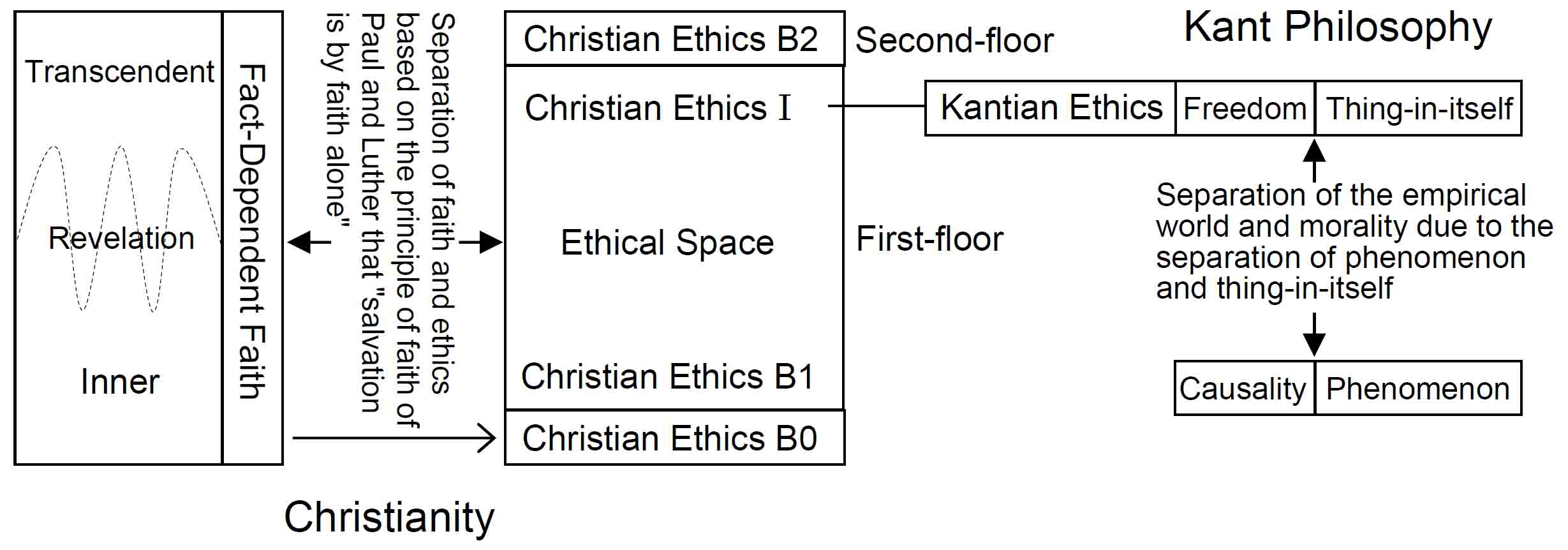
I think of this as something that should be a two-story building. The first-floor is where the individual human rights mentioned above are protected, and the second-floor is where religious truth is placed. The first-floor is where the principle of "rights take precedence over truth" mentioned in Chapter 2 - Essay 2 comes into play, and the second-floor is where religious truth claims are maintained without any coercive power on others.
If we consider the guiding principles of this first-floor ethical space from the perspective of human rights that must be protected, it is possible to find them in natural law and Kantian ethics. This is because natural law is a law that stipulates that no positive law can deny basic human rights, and the "categorical imperative" of Kantian ethics is a law that aims to ensure that all human beings have a universal nature that does not hinder one another.
However, when it comes to natural law and Kant's ethical thought, there are pros and cons about seeing it as being on the same footing as Christian ethics.
This essay argues that the faith-ethics structure in Christianity, which separates faith and ethics, makes it possible for ethics to be independent from faith. Therefore, this essay holds that Christian ethics can exist apart from the literal interpretation of the commands written in the Bible, that is, apart from the positive law of the Bible. Therefore, even if law or Kantian ethics does not have its origins in Christianity, it is affirmed that it can function as a guiding principle in the first-floor of Christian ethical space. And it is here that Christianity finds a space where it can share and collaborate with other religions and philosophies. (Argument 1-3)
Christianity contends with other ideologies and religions regarding the truth of facts, including God (Chapter 2 - Parable, Essay 2), but when it comes to ethics related to value judgments, it cooperates with ideologies that share the same values. Christian faith is fact-based and must not depart from the literal text of the Bible; therefore, it cannot be shared with other ideologies or religions. However, Christian ethics are non-fact-based and should develop rather independently from the literal text of the Bible, thereby enabling shared ground with other ideologies and religions. In this essay, Kantian philosophy is overcome in terms of epistemology, which is related to the recognition of facts (Part 2 Chapter 4), but it coexists with Kant in terms of ethics.
The fact that salvation in Christianity is "by faith alone, not by works" means that our works are no longer for the sake of salvation. That is, when works were once linked to faith, ethics as works were inseparable from one's own happiness, which is salvation, but when salvation became "faith alone", ethics became something that was not for oneself but purely for others.
This is good news for me. I am not one who strives for good deeds, but if ethics are not for my own salvation, then I can turn my thoughts to good deeds without reservation. By doing good deeds, there is no need to be suspicious of my own greed anymore. In Chapter 1 - Essay 2, I wrote that "virtue, which is maintained because one is convinced that things one cannot see are true, is the worse than the obvious profit-seeking of prosperity for business, because the more the motive is hidden", but the independence of ethics from salvation frees me from this doubt.
In Kantian ethics, only morality for morality's sake is considered to be true morality. It is a principle that denies that morality is ultimately a means to realize one's own desires. It can be said that Christianity also realizes the same non-fact-based ethics through the faith principle of "faith alone" of Paul and Luther. This could be seen as a transition from Jesus' fact-based ethical teachings (Chapter 1 - Essay 2), which were familiar to the Jewish faith.
In this way, the first-floor of the Christian ethical space exists as the floor of human rights. There, even if an act is condemned by a specific religion or ideology, as long as it does not infringe upon the human rights of others, the goal is that the person who performs it should not suffer disadvantage from society or the law. This is because this first-floor ethical space places the fundamental rights of individuals above religious truth.
The second-floor of the Christian ethical space is the floor of religious truth.Here are gathered all the commands of Scripture, with the exception of the two ethical principles mentioned above and a few exceptions such as Philippians 4:8 and James 2:16.
It is probably impossible to argue that the Bible does not prohibit homosexuality, no matter what interpretation of the Bible is adopted. Interpreting this prohibition as open to reinterpretation in the same way as commands such as women wearing head coverings would be a stretch.
That said, given the human rights of homosexuals, even if they cannot escape religious condemnation, there is no reason why they should be subject to social discrimination or legal disadvantages. In this sense, Christian ethics must protect its people by the first-floor of the ethical space. Again, this is because on the first-floor individual human rights are placed above religious truth.
However, if we ask the question, "Should Christian ethics abandon the teachings in the Bible prohibiting homosexuality?", I do not think that this is necessarily the case. Needless to say, it is possible that in the future it may become clear that such people's sexual orientation is purely physiological, just like everyone else's, and so this injunction may have to be treated like any other biblical commandment that is time-dependent. In that case, it is necessary to reach the conclusion that the Bible's teachings against homosexuality should be reinterpreted in accordance with modern perspectives.
However, in the current situation where such scientific facts are not clear, viewing the actions of such people as objectionable from a religious or moral standpoint, we should not reject efforts to recover them from such situations. This is because the Bible teaches that the actions it criticizes, even if no one is harmed by them, are sins against oneself or against the body given to us by God (1 Cor. 6:18).
That is to say, Christian ethics is not an ethics that is complete in terms of relationships between human beings, but an ethics that includes maintaining the dignity of human beings as God's creatures. It is also required Christian ethics to maintain a religious aspect that sets it apart from ethics in general.
Therefore, when trying to adapt Christian ethics to changes in scientific knowledge and social awareness, it is not enough to simply make them pander to these changes. Knowledge is constantly evolving, so we must always keep in mind that what is currently considered the most current and prevalent view may be overturned.
Wherein, on the second-floor of the ethical space, the unique Christian value of being a creature made by God is maintained, and therefore the "faith-based ethics" that says "Follow God's example, therefore, as dearly loved children and walk in the way of love" once again becomes relevant as an ethical motivation. To the extent that faith is involved, this second-floor ethics become fact-based ethics. That is to say, it clashes with other values.
Thus, second-floor ethics involves literally asserting and proclaiming to others the teachings of the Bible, particularly those of a religious nature. However, by prioritizing the ethical space of human rights - that is, by prioritizing first-floor ethics that are separate from fact-based faith, second-floor ethics maintains the non-fact-based nature of Christian ethics that this essay asserts. In other words, even though it has a religious second-floor ethic, Christianity retains its non-fundamentalist nature.
〈Model for Christian Ethics〉⇧
Based on what has been said thus far, let us organize the nature of non-fact-based of Christian ethics and construct a Christian ethical model.
The biblical ethics described as two types of ethics in Arguments 1-3 are called "Christian Ethics B (Bible)". Within "Christian Ethics B", "faith-based ethics" will be called "Christian Ethics B0", "command-based ethics" will be called "Christian Ethics B1", and most other biblical commands will be called "Christian Ethics B2".
Kantian ethics, which was previously established as the guiding principle for the first-floor ethical space, is called "Christian Ethics I (Ideal)". Kantian ethics is a Non-fact-Dependent ethics (Chapter 1 - Easy study), so it has an affinity with the nature of non-fact-based of Christian ethics, and since its ethics are also called idealist ethics, this name is appropriate.
Kantian ethics considers it contradictory for actions to contain practical motives, and therefore requires us to have a noble will. Therefore, it must be said that this is an ethics that has problems with its effectiveness in terms of practicality (Chapter 1 - Reflection). However, there is no contradiction between the fact that it is difficult to implement and the fact that it is an ideal to be aimed for, so there is no problem with making it a guiding principle.
Christian ethics B0 gives rise to an ethics motivated by saving grace, which is the starting point of Christian ethics. Christian ethics B1 is based on the two commandments of Jesus, "Love the Lord your God" and "Love your neighbor", and constructs an ethical space that conforms to these principles independently of the text of the Bible.
In this case, if Christian ethics B1 is a constraint from below on the first-floor of the Christian ethical space, then Christian ethics I according to Kantian ethics is a constraint from above. The first-floor of the Christian ethical space is formed by fulfilling the principle of "Love your God" and "Love your neighbor" while aiming for "universal validity" in which all people can share that ethic.
The second-floor of the ethical space (Christian ethics B2) is a floor that asserts the religious ethics written in the Bible, again motivated by Christian ethics B0, which says, "Follow God's example, therefore, as dearly loved children". That is to say, even if an action does not infringe upon the human rights of others, this space questions whether it does not infringe upon God's will.
■ Hierarchical Model of Christian Ethics
| Christian Ethics B2 | second-floor Ethical Space for Maintaining Religious Ethics |
| Christian Ethics I | Ethics as the guiding principle of the first-floor of Christian Ethical Space |
| First-floor Christian Ethical Space | Ethical Space where Basic Human Rights take precedence over Religious Truth |
| Christian Ethics B1 | Ethics based on two commandments taught by Jesus |
| Christian Ethics B0 | Ethics motivated by gratitude for the forgiveness of sins |
■ Details of Christian Ethics B0, B1
|
|
Christian Ethics B0 | Christian Ethics B1 |
| Ethics name | Faith-based ethics | Command-based ethics |
|
Bible passages used as the basis for the argument (See 'Arguments 1-3' for Scripture) |
Colossians 3:12 Colossians 3:13 Philippians 1:27 Ephesians 4:1 Ephesians 5:1 1 John 4:11 |
Galatians 5:14 Romans 13:9 Matthew 22:37-40 |
| Types of Ethics | Beneficism | Principle-Based |
| Foundations of Ethics |
Ethics that motivates one to live a life worthy of salvation "Forgive as the Lord forgave you." (Col. 3:13) |
Ethics based on the will to follow the two commandments Jesus taught "Love the Lord your God with all your heart and with all your soul and with all your mind." (Mt. 22:37) "Love your neighbor as yourself." (Mt. 22:39) |
| Formation of Ethics | The origin of Christian ethics | The foundations of Christian ethics |
| Sustainability of Ethics | By looking to salvation | By looking to the teachings of Jesus |
| Literal or Not? | Accepting the literal meaning of the Bible regarding salvation gives rise to Christian ethics B0. | Jesus' "two commandments" are Christian ethics B1. All commands written in the Bible are reconsidered in accordance with the "Two Commandments", and ethical judgments not written in the Bible are made based on the "Two Commandments". These elements constitute a "first-floor Christian ethics" independent of the Bible, built upon Christian ethics B1. |
〈The separation of facts and ethics in Christianity and Kantian philosophy〉⇧
As we have seen above, both Kantian ethics and Christian ethics are non-fact-dependent ethics. In fact, both Kantian ethics and Christian ethics are ethics that are not bound by facts, and the circumstances under which this is realized are as follows.
The central rule of Kantian ethics, the Categorical Imperative, requires the will that is free from desire and not subordinated to pleasure. For this reason, Kant's morality belongs not to the empirical world of "phenomenon" governed by the laws of causality of the understanding category, but to the transcendent world of "thing-in-itself" where the laws of freedom are possible.
This is the structure of the separation of ethics and facts in Kantian ethics. Therefore, the Non-fact-Dependent nature of Kantian ethics is not only due to the fact that the "categorical imperative" is based on the rejection of utilitarian motivations, but also because the worldview of "separation of phenomenon and thing-in-itself" in Kantian epistemology is the principle that brings about the separation of ethics and facts.
On the other hand, Christian ethics is separated from facts due to Paul and Luther's principle of faith that "salvation is by faith alone". This is because, since Christian faith is a fact-dependent faith, the separation of ethics and faith is the separation of ethics and facts.This forms the basis for interpreting the commandments in the Bible in a non-fact-dependent, or non-literal, manner.
Both Kantian philosophy and Christian ethics establish an ethics that prioritizes human rights by separating ethics from facts. Although the separation of ethics and facts occurs in different ways in both cases, the following similarities can be observed.
In Kantian philosophy, ethics is said to belong to thing-in-itself, but these ethics are realized in the phenomenal world through our practice. This means that there is an expression of the thing-in-itself in phenomenon, which creates new challenges for Kant's epistemological system. This is because the "separation of phenomena and things-in-themselves" is the basic framework of Kant's epistemology.
In order to resolve this situation, which could be seen as a contradiction, Kant identifies within our cognitive faculties, in addition to sensibility, understanding, and reason, a further ability called "judgment", which is the ability to discover transcendent phenomena in a purposive form within the internal world, and he describes this in his Critique of Judgment.
The Critique of Judgment, which brings The Critique of Practical Reason, which sees transcendence in human will, into line with The Critique of Pure Reason, may, depending on how it is interpreted, be consistent with the biblical view of humanity as created in the image of God and as still bearing the image of God even after the Fall.
Ethics of Christianity has ceased the role concerning salvation that they bore during the Jewish era. In this sense, faith and ethics in Christianity are completely separated with regard to salvation. However, when it comes to moral practice, Christian ethics is motivated by salvation, and needless to say, in this sense Christian faith and Christian ethics are connected.
Nonetheless, it is a psychological connection from faith to ethics (B0), whereby ethics gains power from faith, but faith does not gain power from ethics; namely, faith does not take energy away from ethics. In Jewish times, ethic devoted most of its energy to faith. However, that situation no longer exists. In this way, ethics was no longer for the purpose of salvation, and so it had the capacity to surplus power and became independent from faith. This essay sees this situation as the separation of faith and ethics.
Faith is for one's own salvation, so there is nothing great about having faith. Christian ethics linked to heavenly salvation can even be greedy.
However, since it is difficult for humans to adopt Kant's strict ethics as is,
In any case, it is certain that salvation and faith are only for oneself, and faith is not ethics for others. Nevertheless, salvation and faith remain important to us. Because, if there is no forgiveness of sins and our hearts remain closed, we cannot turn our hearts to others.
〈How to read the Canaanite Conquest by Ancient Israel?――Response from Christian Ethics Independent School〉(Feb. 2025) ⇧
After I finished writing this essay, a paper titled "How to Read the Canaanite Conquest by Ancient Israel: Who Commanded to Slaughter the Enemies?" was published in the January 2025 issue of Evangelical Theology, Issue 54. This serves as a convenient resource for considering the relationship between faith and ethics in Christianity that discussed above. (Given that the subject matter is "war", I would prefer to avoid terms like "convenient".) Using this as a topic, I would like to consider how we can understand the account of Israel's invasion of Canaan when we understand Christian ethics as being independent of faith. Can the faith principles of Paul and Luther address this practical problem while maintaining their position as principles that provide the "desirable Christian ethics to be aimed for" as stated at the beginning of this section?
The summary of the paper is as follows:
How should we interpret the Old Testament accounts of violence in the invasion of Canaan and of war itself? These descriptions are confusing today's Bible readers. Traditional theology has responded that the invasion of Canaan was "right because God commanded it, even if humans cannot understand it" or that it served "the good purpose of punishing the wickedness of the Canaanites." However, this leads to the justification and excuse for wars waged in the name of God today.
Archaeology and ancient Near Eastern studies reveal that the command to "Ban" (utterly destroy - Josh10:39 NIV) in the Book of Joshua was not actual but an exaggeration to emphasize the accomplishment, and that the account of the war oracle in which "the Lord said to Joshua" was a common phrase used to justify war in the Oriental society of the time. Rather, the Pentateuch and the Book of Joshua contain passages that can be interpreted as acts of tolerance, such as "drivie out the Canaanites, Amorites, ... (Ex. 33:2 and many others)" before battle, and the Book of Isaiah contains prophecies of peace.
However, the problem with the battle accounts in the Book of Joshua lies not in the scale of the wars or the presence or absence of tolerance, but in the brutality of killing noncombatants and permitting rape. The problem is that there is a record that God commanded such things. Even if Israel's warfare methods were not particularly vicious or ruthless compared to those of its neighbors at the time, the existence of atrocities committed by ancient Israel cannot be denied and these acts cannot be defended.
After the above considerations, paper author Jun Sato states the following conclusion:
The account of the invasion of Canaan was written by the victorious Israelites, and therefore may not be an accurate account of historical fact. Furthermore, the records contain exaggerated military achievements and oracle-like phrases, which were constrained by the constraints of Oriental society at the time. If we take this story literally without considering these points, we will not be able to deny the wars being waged in God's name that are still being waged today.
However, when the account of the invasion of Canaan is interpreted in the context of the ancient Orient, it becomes possible to see the origin of oracles in times of war not as coming from God, but as a reflection of theological will and faith on the part of humans. Based on this understanding, it can be said that ancient Israel waged war in the name of God and in the oracles of God, and that humans were responsible for ordering the massacre of Canaan.
In any case, if we attribute the source of the Old Testament testimony that "God ordered the genocide of the Canaanites" to God, then we cannot escape the structure in which Christianity supports and affirms war, and it would be impossible to reconcile this with the desire for peace without war.
The author of the paper suggest that humans, rather than God, may have been responsible for the Canaanite massacre. He states that without adopting this view, Christianity would be unable to reject the wars that are waged in the name of God today, and would be incompatible with the desire for peace.
Although, in either case, a definitive conclusion is avoided, it is understood that the author wishes to conclude that the Old Testament's account of the Canaanite massacre is a "story" that follows the writing conventions of the ancient Orient about an actual invasion of Canaan. The reason I feel this way is also because the title of the paper contains the word "story".
Now, if we try to maintain the justice of the God of the Old Testament, which is connected to the Christian God, by attributing the atrocities of the invasion of Canaan entirely to human actions and viewing the accounts as an expression of ancient Israelite ideology rather than as literal divine revelations, then a fundamental problem seems to arise.
It is "Where can we find the concept of God?", which is a question of bibliology. If we dismiss this question by saying, "No, no, the accounts of the Bible do not necessarily have to be understood as divine revelation", then the topic of "How should we read the account of Israel's invasion of Canaan?" becomes an attempt that is determined to persuade people to accept the Bible as a record or story written by humans, rather than as the word of God.
For in that case, because it means the reason "today's Bible readers are confused" would simply be because their view of the Bible is incorrect. That may be true. However, the acts of aggression recorded in the Old Testament as actions of Israel have long been a topic of discussion as part of the "problem of evil in God".
If we regard the Bible as merely human words, this kind of subject is easily answered and ceases to be worth discussing at all. Even if a debate were to take place, the binary structure of "the word of God or the word of man" would make the discussion lack depth. If we did not need to look for a concept of God in the Bible, no one would be confused by such issues, and there would be no "problem of evil in God".
Biblical interpretation here is not about judging whether the Bible is "the word of God or the word of man," but rather about how we can find the will of God, the Father of Jesus in whom we believe, in the Bible, which was undoubtedly written by humans. (No one would dispute that the Bible was written by men.) Therefore, this must be dealt with while maintaining an awareness of "where to look for the concept of God."
Wherein, I begin with the classifications of evil described in the Bible. When viewed from the perspective of the consciousness of the Bible writers, descriptions of evil or sin in the Bible can be divided into three types.
1.Passages that consciously and critically depict evil. (David's sin, Achan's sin, Moses's impatience at the rock watering place, etc.)
2.Passages that actively describe actions that appear to be evil. (Invasion of Canaan.)
3.Passages in which evil is written without the Bible writer's awareness. (Israel's behavior after settling in Canaan, David's marriage after his sin.)
There is no issue with viewing point 1, which consciously and critically portrays evil, as an expression of God's will. The problem is that the actions appearing to be evil in point 2 are explicitly written as God's will, but setting that aside for now, how should we judge the passages in point 3 that seem to describe sin being committed unconsciously?
I have pointed out some articles of this kind in Argument 1-2, so please check them out. As is well known, David committed the sin of legally murdering Uriah in order to obtain his wife Bathsheba. However, after the repentant David took Bathsheba as his wife, the "biblical account that gives the impression that the matter was resolved" overlooks his further greed. The Book of Ruth "idyllically" depicts Boaz sharing the harvest from the land that his predecessors had seized in their invasion of Canaan with the widow Ruth, yet this too is difficult to accept from a modern perspective.
If we judge here that description 1 is in accordance with God's will and description 2 was committed by humans, then how should we judge description 3? Wouldn't that inevitably lead to an ambiguous judgment?
This difficulty arises because descriptions 1 and 2 assign responsibility to God and humans, respectively. As a result, problem about 3 arises, but not only that, this allocation, based on the intention to make God good, also gives rise to the problem that the concept of God becomes arbitrary and based on human judgment. If we attribute what we see as justice to God and what we see as sin to humans, then God becomes a god created by our sense of justice.
Therefore, we are tempted to conclude that either 1, 2, and 3 above all express God's will in some sense, or that they are all the work of man and therefore no knowledge of God can be gained from the Bible. This way, neither the ambiguity issue in point 3 nor the problem of arbitrariness in the concept of God arises, and the problem becomes simpler.
However, this would invite the very criticism that I leveled against the "Bible Faith" argument in Arguments 1-3: that "drawing a line at 100% simply because it is difficult to distinguish between the inspired and non-inspired parts of the Bible is an easy way out and leads to crude reasoning."
That is to say, we cannot say "okay" about either dividing the biblical accounts between God and man, nor leaning too heavily towards one or the other. What is required here is the patience to continue standing in an indecisive position, with judgment suspended. However, regarding the following, we should not reserve judgment, but rather say, "We will judge."
That is, when it comes to acts of extreme evil, we do not attribute them to God, even if we are unable to fully understand Him. If we did not do so, it would only add further confusion to our understanding of God.
Such a reduction of God to a completely meaningless being is an estranged attitude toward God, like the "wicked servant" in the parable of the ten minas in Luke 19. He did not understand his master and thought of him as "a calculating, strict, and frightening man who takes what he did not deposit," so he continued to hide the 10 minas. To him, his master was incomprehensible and could be any evil person.
Therefore, when it comes to the accounts of acts that appear to be evil in the Bible, even if it is difficult to draw the line, we should still consider that there is a boundary somewhere between those parts that are attributed to God and those that are not. In this sense, I do not deny the possibility that the view of the author of the above-quoted paper, who attributes responsibility for the invasion of Canaan to humans, may be valid.
However, this is only in regards to atrocities, and I believe that the "invasion of Canaan" itself that the author of the paper speaks of originates from God's will. This is because, if we do not return responsibility to God at all for the invasion of Canaan, then the fundamental question I raised earlier, namely, "Where can we find the concept of God?", will resurface.
From the Exodus to the founding of Israel by Saul, the invasion of Canaan is a central event in history. If we do not attribute this to God's will, we are compelled to reexamine the fundamental concept underlying Judeo-Christianity: "God's election of Israel". In that case, we would have to say, as the literary saying goes, "God is in the details of the Bible." While it is true that God's will and nature are revealed in the details of Scripture, this does not mean that the major propositions of the Old Testament need not be God's will.
When we consider this problem of evil, we must remember the following: It is the question that do Christianity and the church believe in a problematic God that is difficult for us to understand today? I think so.
In a sense, we believe in a terrifying god. However, when we look at faith in general, it is normal for faith to be accompanied by fear, and this was clearly the case with Israel's faith in God in the Old Testament. The moment we believe that God is the Creator of Heaven and Earth, His terrifying power is more than enough for powerless humans. Thinking of the Christian God as safe and secure, harmless to humans and animals is simply a convenient modern belief.
--------------
In the first place, do we have to defend God as righteous? Is God a being who cannot function unless we humans protect Him? Conversely, whatever God may be, is there any reason why we should be troubled by it? It seems incongruous, or rather presumptuous, for us to be troubled by God.
However, either way, God is undoubtedly an entity beyond our understanding. As such an existence, we have been come to know God through the Old Testament and the New Testament. To give just one more example from the Old Testament besides the invasion of Canaan, there is an account in Genesis in which God Yahweh gives Abraham the difficult task of offering his son Isaac as a sacrifice in the land of Moriah.
And the Jesus described in the New Testament was killed without being understood by the Jews, and his disciples, too, without understanding him, fled in fear of the crucifixion. We are told that Jesus was also difficult to understand.
If even Jesus, who was deemed equal to God and appeared before human eyes, is thus, then should not the primary principle of understanding God be to perceive the hidden God as an even more incomprehensible being? It was only later that God's will in both the attempted sacrifice of Isaac and the accomplished death of Jesus was understood. Therefore, it would not be wrong to say that the invasion of Canaan is still difficult to understand today.
Moreover, if we dare to recall, the God taught in the New Testament will judge at the end of time. Jesus also spoke of eternal torment in hell.From a normal perspective of human rights, this would be unjust, because, needless to say, even serious criminals have human rights. However, God does not shrink from judgment that amounts to eternal human rights violations. This signifies that God possesses a severity where human rights hold no sway.
We tend to overlook this aspect of God as taught in the New Testament, yet Christianity is a religion that embraces such a God. The attempts to somehow mediate God's atrocities, as recorded in both the Old and New Testaments, are similar to the scene in which Peter admonishes Jesus when he begins to speak of his own death. Jesus rejected Peter's advice, and neither does God expect us to intervene.
We are on God's side, and we never seek to stand as understanding neutrals between humans and God. Though God is hard to understand, we stand with the Father whom Jesus believed in and taught us about, based on some kind of certain belief in Jesus. (The formation of "some kind of certain belief" regarding Jesus was discussed in Chapter 3.)
However, even if we say we are on God's side, we should not be like the friends who advised Job when he was suffering from God's trials. They act as if they know God, trying to silence Job's doubts about Him. But doubts about God must be cherished. For it can deepen one's understanding of God. Conversely, to fill God with question marks and declare that it doesn't matter if God is evil, cruel, or anything else is the mindset of the “wicked servant” in the parable of the ten minas. We do not stand on God's side as if we understand His will, nor do we distance ourselves from Him as a God who makes impossible demands; rather, we stand on God's side simply through faith in Jesus, even though we do not understand.
We may confidently assert that God is a holy being distinct from humanity. However, it is more accurate to say that we cannot assert whether God is the kind of being of justice that we imagine. Beyond doubt, justice is an attribute of God, though it may be subordinate to other attributes that contrast with what we think of as justice. Such matters are not up to us to decide, and it would be pointless for us to decide them.
--------------
That is to say, while we cannot attribute the accounts of brutal acts in the Old Testament to God, we must nevertheless bear in mind that God is beyond our comprehension. Otherwise, God would be easily placed under our own ideas, and we would end up manipulating our concept of God.
In the Christian faith, we know of no other god than the God conveyed in the Old and New Testaments. Even if it was merely the faith or ideology of the ancient and first-century Jews, there is no way to know the God of the Bible outside of their faith and thought. We must admit that we know no other gods than the God described in the Old Testament, and the same is true of the New Testament. We take upon ourselves the God conveyed there, and we bear the responsibility for doing so.
Wherein, returning to the responsibility here, or the question posed here, the question is how can we do good and assert justice while believing in such a terrifying God? While attributing the accounts of the Old Testament's terrible wars to God to some extent, how can those who believe in such a God proclaim peace?
I don't want to make this a question of draw the line in the Bible as to what God's will is. As I mentioned earlier, that boundary must be somewhere in the Bible. To say here that all of the events recorded in the Bible are God's will is the same as saying that plane crashes are God's will. That's a wild and almost meaningless way of thinking.
Therefore, unless we abandon the Bible, we must consider that the boundaries of God's will exist in detail throughout the Bible, and in multiple layers in each passage. However, such a judgment is actually impossible. As we saw above, there are points where the judgment must inevitably be ambiguous, and there are countless possibilities that God possesses a different kind of goodness from what we consider good. In other words, it is not within our power to determine God's intentions or to act as mediators between God and humanity.
Therefore, it is my view that the resolution of the articles concerning Israel's invasion of Canaan should not be treated as a biblical boundary issue. That is, I do not reconcile the article with the peace argument on the basis of whether or not God is to blame for the invasion of Canaan. I cannot strictly agree with the author of the cited paper's line of "attributing the atrocities of the invasion of Canaan to humans," and even more than that, I am opposed to dealing with this issue by drawing a line at all.
And in fact, this problem can be solved by setting aside such boundaries. This is because this very solution is made possible by the fact that faith in God the Father and exhortation to good works toward one's neighbor――that is, faith and ethics――which were previously united in Jesus' Sermon on the Mount, have evolved into separation.
We believe in a God who wages war and judgment, but we practice an ethic based on Jesus' command to "love your neighbor as yourself." This is made possible by Paul and Luther's principle of faith, which states that faith is only related to salvation and that ethics has a separate role. Regardless of what we believe to be true, our actions are based solely on Jesus' commands.
――――――――
In present-day Israel, a Jewish religion nation that lacks this principle, there is no principle that allows one to prioritize love for one's neighbor while maintaining faith in God. In the Old Testament era, Israel had "the Ten Commandments" and "the Abrahamic Covenant (see Argument 1-2)". This is the ethics and faith of Jewish religion Israel, which corresponds to the "Sermon on the Mount" and "faith of salvation" of the New Testament era.
Regarding the Ten Commandments and the Abrahamic Covenant, it is possible to view the Abrahamic Covenant as a promise of God's extra-legal will that exempts the Ten Commandments' command "Thou shalt not kill," or to view the Ten Commandments as a condition for God to fulfill the Abrahamic Covenant. In both cases, however, the Ten Commandments are subordinate to the Abrahamic Covenant. In other words, ethics in the Old Testament was subordinate to faith.
Therefore, the more thoroughly they adhere to their faith, the more the harsh behavior described in the Old Testament as God's command becomes apparent. This situation remains unchanged to this day. This is the structure of fundamentalism in which ethics are not independent of faith, but are at the mercy of faith. The Ten Commandments, being subordinate to faith, cannot restrain the actions that faith commands.
When we attribute the Old Testament invasion of Canaan to a sovereign act of God, we cannot say anything definitive about whether it was God's just and fair dealing with Canaan and Israel. The act seems like a dirty job that God has undertaken.
However, it can be said that God has done as much good as possible in each era. Although it is different from the standard of good in our time, it may be that God's justice brought order to the ancient world in the form of good for Israel. In other words, the justice of God that is possible in a fallen human world must necessarily be a justice of a gradual in nature throughout history. That said, it is difficult to say for sure.
Alternatively, just as we could not know salvation and the faith that is associated with it without divine revelation,
Therefore, we should not say, "The invasion of Canaan is incomprehensible, but it was a righteous act of God." It is also inappropriate to assert that "the past invasion of Canaan was simply a sinful act on the part of humans and contrary to God's will." These are not because we understand the boundaries of God's will, but because we are simply drawing extreme lines in order to solve problems.
――――――――
We should not conclude the issue in this way, but simply look to the principles that have been given to us as to how ethics should be practiced now; namely, rather than making any kind of boundary judgment to make God good, we should continue to stand on God's side by prioritizing following the teachings of Jesus. Standing on God's side is our alternative to upholding God's justice.
Now that we have Jesus and the New Testament, we no longer need to, and should not, practice the provisional form of righteousness like "those who did not receive what was promised (Heb.11:39)". While maintaining faith in God of the Old Testament that cannot be fully encompassed by notions of goodness or justice, we nevertheless practice the two commandments Jesus taught in this world.
This is because when Jesus was asked by the lawyer, "Which is the first commandment of all?", he answered that the first commandment was to love God, and then he said, "The second is this," and taught, "Love your neighbor as yourself" (Mk.12:28-31). Although asked, “Which is the first of all?” Jesus said there were two. In Matthew's Gospel, Jesus is recorded as saying, "And a second is like it (the first)" (Mt.22:39).
That is to say, the ethic of loving one's neighbor is a principle of Christian life that is second to――but equal to―― the faith of loving God; and, therefore, the two are independent of each other. As mentioned earlier, Paul and Luther's principle of faith that salvation is by faith alone means that ethics are not involved in salvation. Nevertheless, Jesus teaches that both faith and ethics are equally important. This means that ethics have an importance independent of faith. Therefore, maintaining faith in God and ethics toward one's neighbor equally is what modern Christianity should be like, as this essay presents it as an "Christian Ethics Independent School".
The approach of the “Christian Ethical Independent School,” which sets aside right and wrong of the invasion of Canaan and instead prioritizes following Jesus' teachings, is not the same as the “Christian Enlightenment” perspective, which disregards the veracity of biblical accounts and focuses solely on the importance of Jesus' teachings. The issue of the invasion of Canaan can be put aside because it does not relate to the beginning of the Christian faith.
As repeatedly confirmed in Chapter 1, Christian faith is a Fact-Dependent Faith on events recorded in the Bible. Therefore, the authenticity of the accounts of Jesus relating to the origins of Christianity, including his resurrection, is important, and the historical veracity of the accounts of the invasion of Canaan is also important.
However, the right and wrong of the invasion of Canaan in the Old Testament are not factual judgments but value judgments. It is not a condition for the establishment of Christian faith. If the story of the invasion of Canaan were not true, it would not be a good news for the Christian faith, but rather would be a fair bit fatal to Christianity grounded in factuality. However, if the invasion of Canaan is judged to be evil, or if no judgment can be made, this is a matter of moral value judgment and therefore does not apply. This is why we can set aside the question of whether the invasion of Canaan was right or wrong.
However, I must reiterate that "Christian Ethics Independent School" do not seek to make Christianity a moral religion by setting aside the factuality of all biblical passages. I believe that the correct way of Christian ethics is to maintain the orthodox principle of "the Fact-Dependent Faith", while receiving help from faith in terms of ethics but not being bound by it.
In other words, as stated at the end of the previous paragraph, Christian ethics is connected to and based on saving faith in Christian ethics B0, "Be as one who has received God's mercy". Without this B0, it is impossible to put into practice Jesus' Christian ethic B1, "Love your neighbor as yourself". This is because humans cannot live by orders and obligations alone. Based on this recognition, Christian ethics B1 constructs an ethics that is independent of faith.
Based on the above, this essay asserts the following as a conclusion regarding the above cited paper. Even if Christianity attributes to God the source of the Old Testament testimony that "God ordered the genocide of the Canaanites", it possesses a principle that allows this to coexist with the desire for peace without war. This is the "separation of faith and ethics" based on the principle of faith of Paul and Luther. In religions where faith and ethics are not separated, prioritizing faith as something that transcends good and evil will lead to fundamentalism, and prioritizing ethics in an attempt to avoid this danger will result in placing the good and bad of God's will under human judgment.
The author of the cited paper concludes that "attributing the source of the Old Testament testimony to God would amount to approving modern wars that are waged in God's name". This appeals to us today, who are witnessing fundamentalist wars, to adopt a biblical understanding that prioritizes ethics over faith when it comes to the account of the invasion of Canaan, but, as noted above, this gives rise to the undesirable situation that is the counterpart to fundamentalism, in that it places God's actions under our judgment. Its destination is modern Enlightenment Christianity.
However, this is a dead end that Judaism, which only has the Old Testament and remains "faith-ethics indivisible", must fall into, and Christianity will not be forced into that situation. If this is argued as inevitable in Christianity, it means that faith and ethics in Christianity are understood in the same way as in Judaism.
Conclusion
(1) Any interpretation that does not acknowledge any divine intention in the account of the invasion of Canaan is out of the question in the belief that the Bible is the word of God.
(2) Ensuring God's justice by drawing a line at the specific content of the account of the invasion of Canaan and dividing God's involvement from human actions is an arbitrary judgment no matter how it is divided, and it places God's justice in our judgment, so it is a wrong way of understanding God.
(3) Therefore, we conclude that the account of the invasion of Canaan cannot be reconciled with our conception of God's justice, but this does not mean that God is evil, but rather that we must remember that God has aspects that we cannot understand.
(4) However, even if we adopt the view that God is an incomprehensible being, or even if we adopt the interpretation that the invasion of Canaan was intentionally carried out by God, this does not make it impossible for Christians to wish for peace without war. This is because, in Christianity, the principle of the "separation of faith and ethics" holds that faith and works are not one principle but two distinct principles.
(5) This principle of the "separation of faith and ethics" makes it the correct Christian attitude to carry out Jesus' command to "love your neighbor as yourself" without hastily justifying God by attributing the invasion of Canaan to humans.
〈Postscript〉(May 2025) ⇧
Recently, a study group on the topic of "War in the Old Testament" was held by the Japan Evangelical Theological Society.
When the question and answer session began, I asked the main speaker, Mr. Sakon, the following question:
"Regarding the account of the 'The Ban (Utterly destroy)'
Mr. Sakon stated, "There are researchers who have published studies claiming that the 'Utterly destroy' is a historical fact", and mentioned the name "Römer", and he responded, "But since there is no definitive evidence of what was historically true in the Old Testament era, it is impossible to determine, and I feel that questioning whether it was historical fact or not is largely meaningless."
I also had the opportunity to meet Mr. Sato, and fortunately, he kindly accepted a printed copy of this essay, "Supplement 2". In our subsequent email exchanges, I wrote the following:
"In previous paper, Professor Sato appears to have focused solely on various phenomena that are convenient for Christianity. And it seems that by presenting an interpretation of the Bible based on this situation, you are trying to reveal the inappropriateness of a literal interpretation of the Bible. However, just like Professor Sakon's discussion of 'Utterly destroy', I imagine that Professor Sato's decision on 'Attributing Responsibility to God or to Man' is not necessarily limited to the kind of research that Professor Sato presented this time (which would be effective in avoiding fundamentalist beliefs), but that there may also be research that could lead to something fatal for Christianity. Then, from an academic perspective, I believe that it is necessary to conclude that it is impossible to determine whether the account of the invasion of Canaan should be attributed to God or to man, and that this is an unbiased academic stance. For this reason, I believe that historical evidence cannot be used as a basis for preventing a belief from becoming fundamentalist."
In response, Mr. Sato shared his thoughts on my essay, stating, "I completely agree with your assertions that 'We cannot find in historical evidence the basis for avoiding fundamentalist beliefs' and 'In order to be able to hope for peace without war, we need principles that are separate from the pursuit of historical facts.'"
As Christians, we tend to rely on evidence and research that is favorable to Christianity, and the research itself tends to be biased. In my "The Theory of Faith and Reason", I have made as many concessions as possible to mainline theology and Kantian philosophy before refuting them in order to make the discussion more complete, but I still believe that bias in the discussion has not been completely avoided.
However, if this is merely a bias in the argument itself, it can be countered, and therefore does not render this research inappropriate. An essay is also something that picks up the arguments of the overlooked side. However, when it comes to archaeology and Oriental studies, these are fields of study that involve "physical evidence", so pursuing only biased evidence or interpretations could lead to incorrect judgments, just as it does in criminal trials. Furthermore, presenting such findings to people outside the field, who would find it difficult to refute them, would undermine the credibility of the research presentation.
It is said that as both speakers at this study group acknowledged, there is evidence in favor of Christianity and evidence against it in archaeological and Oriental studies. Given this, we must be cautious about using one side's arguments as a bastion of defense of Christianity, even if it serves as a way to avoid a rigid literal interpretation of the Bible and avoid fundamentalist beliefs.
A Christian researcher must primarily stand on the side of facts, not on the side of Christianity. As confirmed in Supplement 1 regarding the definition of "the fact-dependent of the Christian faith", Christianity is a religion based on facts, not beliefs. We can be an ally of Christianity by being a seeker of truth. Any argument that is in favor of Christian faith will only be detrimental to Christianity if it is not true.
"Standing on the side of the facts" here means accepting that there is evidence both in favor of Christianity and evidence against it. As a result, I conclude that Christians cannot look to these uncertain historical facts for a way to prevent themselves from falling into fundamentalist beliefs. Therefore, in order for Christians who bear the "articles of the invasion of Canaan" in the Old Testament to hope for peace without war, they need a principle other than the determination of Old Testament history which is now almost impossible.
Regardless of what is written in the Old Testament and what Israel did in the Old Testament era, I believe that the principle that allows Christians to hope for peace without war is given by the Christian "faith-ethics independence" brought about by the principles of faith of Paul and Luther. To put it another way, if we take a faith-ethics perspective that sees the ethics of Jesus conveyed in the New Testament as teachings equivalent to faith, then even if we attribute the "Canaan invasion articles" to God's will, there is no contradiction between this and the desire for peace.
〈"Paul Equivalence" as a Principle of Acceptance of the Fact of Resurrection〉(Feb. 2026) ⇧
In the previous paragraph, I stated that "Christianity is a religion based on facts, not beliefs". However, upon reflection, do not Christian believers, at the very beginning of their faith, make a definitive assertion that the event of Jesus' resurrection—which should objectively be uncertain—actually occurred? "The fact-dependent faith" should encourage believers to do so. That said, isn't this just a conclusion that is convenient for faith? In the previous paragraph we stated that what is not permissible in academia, but why can we say that it is permissible in faith? This must be considered.
However, this question contains a certain vague misunderstanding about the relationship between Christian faith and the reality of Jesus' resurrection.
Believers do not affirm the fact of Jesus' resurrection because its reality serves as an advantage to their faith, nor do they affirm the fact of the resurrection because it is essential to their faith being orthodox.
In the first place, post-apostolic believers are not in a position to judge whether Jesus was resurrected or not. Therefore, it should be understood that the general post-apostolic Christian faith does not make any judgment about the fact of the resurrection. Believers affirm the fact of the resurrection not by their own judgment but by accepting the testimony of witnesses, or by the "Volitional Assent" described in Chapter 4 - Confirmation 2.
The Christian faith and the fact of Jesus' resurrection are related as follows:
As seen in Chapter 3 - Proposition 1 - Argument, the apostles of the early church, headed by Peter and Paul, obtained the “resurrection proposition”— an interpretation of Jesus' resurrection — and thereby gained faith in Christ. Here, faith is established based on the event of resurrection, following the sequence: "Jesus' resurrection → acquisition of the resurrection proposition → establishment of faith".
That is to say, the apostles did not accept the resurrection of Jesus as a fact because it was necessary for the establishment of their faith. Even the disciples did not anticipate the event of Jesus' resurrection, and it was their experience of this event that became the starting point for their faith.
The resurrection of Jesus here was not a convenient assertion made by the believers, but an event that they faced as an undeniable fact, just as we encounter any other event, and this put them in a position to testify about the resurrection rather than to judge it. Based on Paul's words in 1 Corinthians 15:14-15, it must be acknowledged that Jesus' resurrection was nothing other than this, and that the resurrection of Jesus testified to by the apostles was, at the very least, not the product of faith.
The apostles simply accepted the resurrection as a fact, and faith followed. In this sense, the relationship between faith and the reality of the resurrection in the missions of the apostles, including Peter, and Paul up to the Athens mission, was that the recognition of the resurrection came first, and faith followed.
However, as discussed in Chapter 3 - Succession, Paul left his resurrection proposition mission behind in Athens and switched to preaching the cross proposition after his mission to Corinth. From this point on, for those who came to faith through Christianity propositions other than the proposition of the cross or the proposition of the resurrection, that is, for us post-apostolic believers, the relationship between faith and the fact of the resurrection is that faith comes first, and the recognition of the fact of the resurrection comes second. How then do we make the resurrection a fact?
However, to reiterate, we are not judging that the resurrection of Jesus is a fact (it is too obvious that we are not in a position to do so), but rather affirming and accepting that the resurrection of Jesus is a fact. The question is how this is done.
If we understand that the orthodox Christian faith is a faith that recognizes the fact of Jesus' resurrection, and therefore that the fact of Jesus' resurrection is automatically included in our faith, then this would be an understanding that confuses the definition of a concept with the possibility of the existence of an actual object that corresponds to that concept, as we saw in Chapter 2 - Argument 3.
As stated there regarding biblical faith there, it is indeed true that Christian faith must be a faith that holds the Bible as the word of God, as defined by Christianity itself. However, whether such faith is even possible, and whether it actually exists as one's own personal faith, are entirely separate questions.
Similarly, how the orthodox Christian faith, which holds that Jesus' resurrection is a fact, is actually realized requires a different consideration that is independent of the definition. Then how do post-apostolic believers, who did not personally experience Jesus' resurrection, acknowledge it as fact?
The fact-dependent of the faith in the apostles' faith in the resurrection proposition is that Jesus' activities and resurrection precede that faith. Similarly, the fact-dependent of the faith in the post-apostolic faith in the cross proposition is that Jesus' activities and death on the cross existed prior to that faith.
That is to say, the cross proposition faith is a faith that arises from an interpretation of Jesus' death on the cross, but it does not involve Jesus' resurrection and is not a faith that depends on the fact of Jesus' resurrection. To put it another way, we, post-apostolic people, are cut off from the event of Jesus' resurrection. Therefore, it cannot be affirmed directly, but only indirectly.
Furthermore, in Chapter 4 - Consideration 1, I wrote that the "belief that the resurrection happened" is a mistaken form of faith, and that no matter how unbelievable the resurrection may be, whether or not it occurred is a matter of knowledge, not of faith. However, I must say this again and again: we, the post-apostolic generation, cannot intellectually ascertain the fact of the resurrection. That is, it's impossible to know that directly. If we can know it, it must be indirectly.
Here, let us recall the description in Chapter 3 - Succession. Until his mission to Athens, Paul had been preaching based on the resurrection proposition, but after experiencing the invalidity of the resurrection proposition in that foreign land, when he arrived in Corinth he wrote that he determined not to know anything except Jesus Christ and him crucified. This means that he has decided to act as if he is unaware of the resurrection in his preaching. Then, in his ministry after Corinth, he shifted the content of his sermons from Jesus' resurrection to his death, and thus the cross proposition was born.
This means that Paul considered the preaching of the cross, which presupposes the death of Jesus, to be a substitute for the preaching of the resurrection, which presupposes the resurrection of Jesus. That is to say, Paul believed that the cross proposition without resurrection, which was preached after Corinth, and the resurrection proposition, which was preached before Athens, had the same effect as a principle for the establishment of faith. In other words, believing in Jesus as the Christ because of the resurrection proposition is equivalent to believing in him because of the cross proposition, and the latter is also a correct way of holding Christian faith.
In this way, faith in the cross and faith in the resurrection are connected in Paul, and faith in the proposition of the cross and faith in the proposition of the resurrection coexist in Paul himself. Let us call the relationship between these two faiths "Paul Equivalence".
Post-apostolic believers who have faith in the cross proposition will affirm the resurrection proposition through this "Paul Equivalence". Since the resurrection proposition faith is faith that the fact of resurrection preceded it, this affirmation leads post-apostolic believers to share the faith of the apostles in believing that the resurrection preceded Christian faith. This "Paul Equivalence" can be understood as the justification for later believers, who were not in a position to judge whether or not there was a resurrection, to affirm the fact of Jesus' resurrection.
Therefore, believers in the cross proposition owe their faith to Paul's recognition of the reality of Jesus' resurrection.In Chapter 2 - Argument 2, we saw that the "Rothe Principle" allows us to base our faith in the Bible on Jesus. Likewise, "Paul Equivalence" enables us to bear our post-apostolic faith in which we hold the factuality of Jesus' resurrection, on Paul.
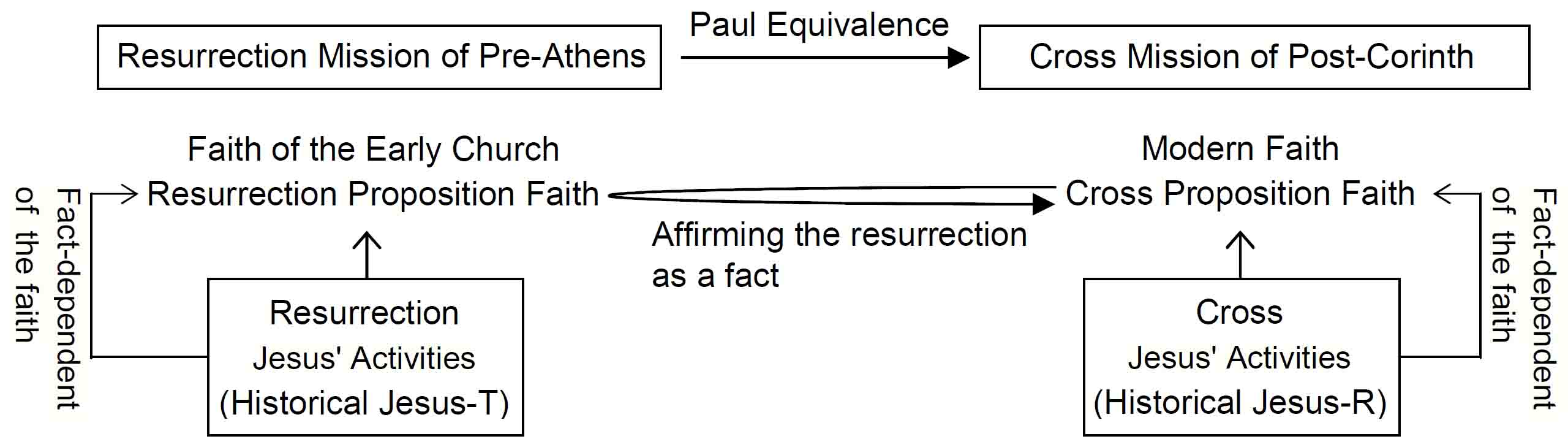
The Faith Structure 2 of The Christianity
(Click here for "Faith Structure 1")
Now, in Chapter 3 - Consideration, I wrote that "Religious doctrines often function as a deceptive logic that by convincing one part convince them of the whole". Doesn't the above “Paul Equivalence” and the “The Rothe Principle” discussed in Chapter 2 - Argument 2 carry that same vibe?
However, in the "Rothe Principle," acquiring Bible Faith means believing in what Jesus believed because one believes in Jesus, and therefore it is different from the structure of "by believing one part believe them of the whole".
The "Paul Equivalence", in which believing in one thing leads to believing in another, is similar in structure to the "by believing one part believe them of the whole", but the "Paul Equivalence" is based on what happened in the heart of Paul, who stands at the origin of the religion of Christianity, and therefore is not simply a "deceptive logic" that makes people vaguely and unreasonably trust the entire religion due to a certain trigger.
Rather, the problem lies in the position of Christianity propositions other than the Resurrection proposition and the Cross proposition. So far, we have thought that Christianity propositions such as "Repetition" and "Religiosity B", mentioned in Chapter 3, are principles for the establishment of faith equivalent to the Resurrection proposition and the Cross proposition, and that there are other Christianity propositions that play a similar role in addition to those mentioned there.
However, if this is the case, then whatever Christianity proposition triggered one's conversion, that faith would also seem to have accepted the factuality of the resurrection in the Resurrection proposition. If this situation is left unchecked, there is a danger that Christian faith will become as vague and unclear as the faith of other religions. Such faith may be seen as employing a "deceptive logic" in which believing in the last allows one to believe in the first.
Once again, we must confirm that only the Cross proposition has the "Paul Equivalence" with the Resurrection proposition. The "Paul Equivalence" is due to the fact that when Paul left Athens and moved to Corinth on his second missionary journey, he equated these two Christianity propositions. Therefore, with regard to other Christianity propositions, even if they lead to faith, they should not be considered to share the factual basis for the resurrection that the Resurrection proposition has.
This means that, as for other Christianity propositions, if we consider them to be part of the process leading to the acquisition of the Cross proposition, which is the principle underlying the establishment of post-apostolic faith, then they can be connected to the Resurrection proposition. Finding God in the solemnity of life (Repetition), using the despair of weakness as an opportunity to recognize God (Religiosity B), and sensing the absoluteness of God (Praise) are undoubtedly religious existentialities that stand at the entrance to Christian faith, but when they lead to repentance through the forgiveness of sins, they can be called Christian faith.